TWO - DAY RADIO TELEPHONY COURSE(S)
(based at our South Wales FRTOL CAA Regional Test Centre)
covering Cardiff, Newport, Swansea, S. Glos & N. Bristol
areas.
RT Licence.
With some prior preparation, you can in a one day (or two
half days) 'brush up' session cover all the theory and practical
requirements of the Flight Radio Telephony Operators Licence
FRTOL (VHF & HF). After training is complete, the written
and practical tests are conducted by our resident UK CAA-authorized
examiner. The results will be known immediately.
Then we send your completed application
form to the CAA, who issue the licence. Usually we limit
the number of students in each of our RT classes to TWO
at a time. This is because the practical test, when conducted,
requires about 2 hours set aside for each candidate.
Details
The course, written examination papers and the practical
test are conducted entirely in English. Therefore it is
important for students to have a reasonable command of the
English language.. If you are not certain about your level
of English, we will help you find out quite easily!. Simply
phone us, (or send for further details and Price
lists) and we will tell you after one
or two minutes of conversation if you are at a suitable
level to take the standard course. Before attending a course
you should first obtain a copy of the CAA publication CAP413.
You can either buy a copy, or alternatively download a PDF-file
from the internet - see our References section below.
CAP413 is the "bible" of radio telephony. It
is a very good document and fairly straightforward to
read. It also covers items that are unique to the UK.
The UK test will make reference to these items, so it
is relevant even if you intend flying in other parts of
Europe. Make yourself familiar with this document before
your arrival (but you do not need to remember every part
of it!). It is our job to teach you the important parts,
so that you will be a safe and efficient pilot whenever
speaking to Air Traffic Control.
Assuming that you have a sufficient grasp of the English
language and you are familiar with CAP413, then you should
have no problem with the theory part of the course, which
consists of the following:-
Day 1: Theory and Written Test
Evolution of controlled airspace and radio procedures.
Definitions. Abbreviations. Call signs. RT protocol. Types
of services available. Flight plans. Flight information
service. Standard clearances, conditional clearances.
LARS and MATZ (in the UK), Transponder usage. Emergency
procedures. ATIS, Volmet. All students then take the written
examination.
Discussion of the RT Practical test followed by individual
practice using a format very similar to the one used in
the actual exam.
Day 2: The Practical Test
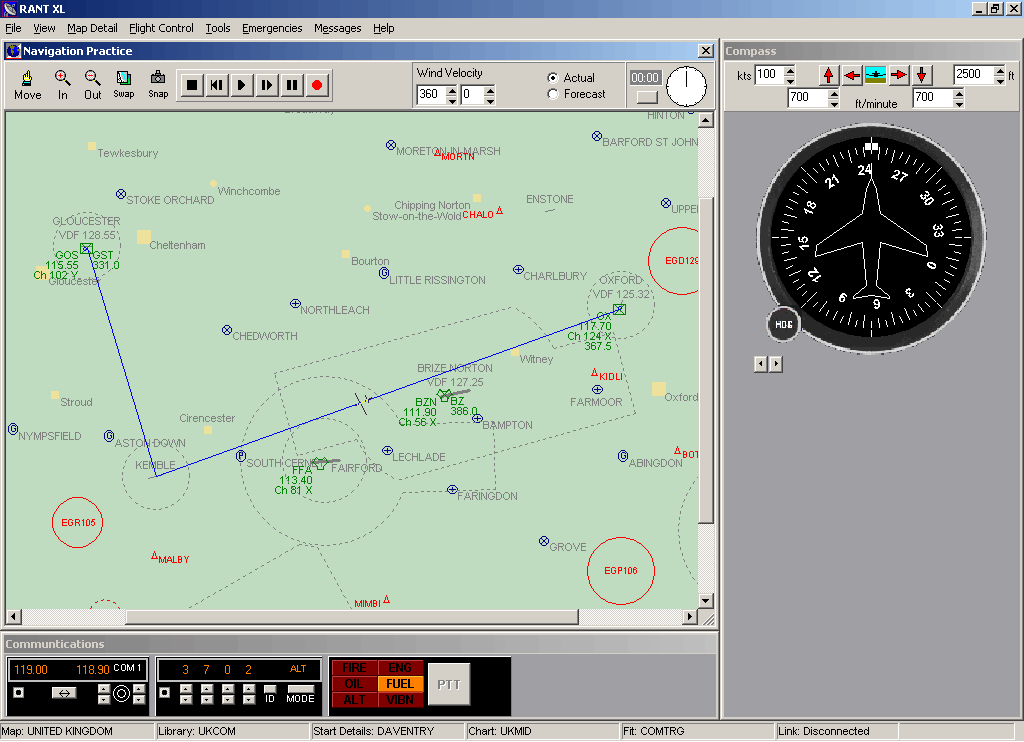
The practical test takes about two-three hours, including
debriefing. Only one student can be tested at a time, so
the last student may have to be prepared to finish later
in the day . You will then be issued with a certified CAA
application form for the RTF licence, which we send to the
address shown on the form. Finally, the licence will be
mailed to you by the CAA.
COMMUNICATION
REFERENCES
1. CAP 413 the Radio Telephony
Manual, is available for download free of charge
from www.caa.co.uk
2. Godwin P (Ed) (2004), Radiotelephony Air
Pilot Publisher Ltd
3. Oxford (OAA) RT multimedia package about £80.
One of the few CBL/ multimedia resources we have
found really useful.
also available from our Pilot
shop.
|
|
Frequently Asked Questions
Q1. Can anyone attend the course?
A1. Well yes certainly - you don't actually need to be
a pilot or have completed any pilot training, although
this obviously helps. In such cases the THEORY will be
covered in a separate ONE day course, and you must pass
the written exam before starting or taking the practical
part of the course. You may also require additional aviation
phraseology practice. Please contact us for more details.
Q2. What if I fail the written communication
examination paper?
A2. There are three different examination papers, so if
you fail the first one, you can take another one, but we
aim to avoid this happening. If you fail that, there is
still one more chance. If that one is not successful, we
have to refer you to the CAA, who will make special arrangements
for yet another test, probably at Gatwick Airport.
Q3. Do students often fail the written
test?
A3. It is quite unusual to fail the first test. It is even
more unusual to fail the second one. In our examiner’s
experience, no one has ever failed the third attempt, although
it is possible that someone, somewhere, has done so.
Q4. What if I fail the practical test?
A4. This does not happen very often, provided the student
or pilot has prepared properly, and understands the subject
matter. There are three different tests that can be used,
so the answer is basically the same as above.
Q5. What is the most common cause of
failing the practical test?
A5. Probably not following the correct procedure with regard
to the emergency situations or making proper reports. It
must be realized that in an emergency, perhaps with an aircraft
descending and on fire, there may be only one opportunity
to transmit the radio call to get help. If this is not done
correctly, in the real world, people may be at risk. In
the test environment, it just means you have to do it again!
Q6. What is the cost of the course? Any conditions?
A6. The ONE or TWO day training courses need to be booked
well in advance (See
price list), but we aim to provide
a confimed reservation for the practical or written tests
within 7-10 days of contacting us.
All required books and pilot equipment are available
from our Pilot
shop at below RRP.Also,
you can order yourself direct from Pooleys
or AFE, and get an immediate 5%
discount by quoting CAMBRIAN
AERO on their order form!!
or
....
CORPORATE
MEMBER & WINGS SCHEME PROVIDER
Cambrian
Ground School is a member of the GTi (Aviation) Business
Network
|